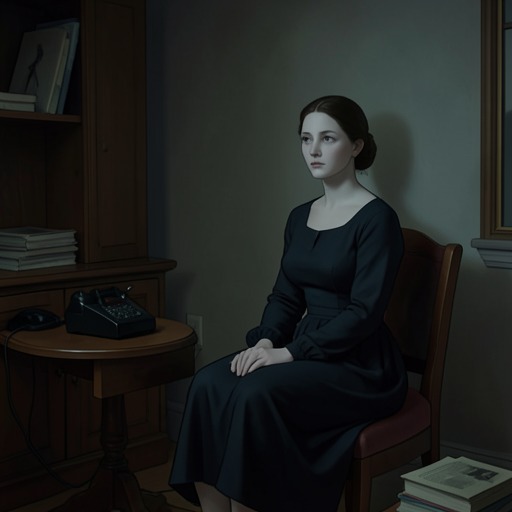
Magdalena—Angustias
The House of Bernarda AlbaMagdalena and Angustias are half-sisters whose relationship becomes a focal point for the tensions created by unequal inheritance and marriage. Angustias, the eldest daughter from Bernarda Alba’s first marriage, is the wealthiest of the sisters; Magdalena, nine years younger and the eldest daughter of Bernarda’s second marriage, sees Angustias’s inheritance and engagement to Pepe el Romano as evidence that family fortune and romantic prospects are distributed unfairly. Their conflict is not simply personal dislike: it grows within a household where money shapes status, marriage offers one of the few imaginable futures for women, and the remaining daughters are expected to spend their lives sewing and waiting.
Family Position and Unequal Inheritance
Angustias occupies a distinct position in the family as the only daughter of Bernarda’s first marriage. Her stepfather, Antonio María Benavides, leaves her substantially more money than he leaves his natural daughters. This arrangement gives Angustias the greatest financial independence among the sisters and makes her an attractive marriage prospect, but it also fuels their resentment. Magdalena’s expectations of inheritance are described as natural, particularly because she appears to have been her father’s favourite; those expectations are nevertheless thwarted by the will.
The distribution of property makes the sisters’ kinship both intimate and unequal. They share a household and a mother, but Angustias’s separate paternal inheritance distinguishes her from the daughters of Bernarda’s second marriage. The commentary raises, without resolving, a further question: whether Antonio María Benavides’s preference for Angustias in his will hints at a closer relationship, and whether Bernarda suspects one. It remains a suggestion, not an established explanation. What is certain is that the will gives the sisters a concrete reason to regard Angustias’s position as privileged, and turns family inheritance into a source of suspicion and bitterness.
The Engagement as a Source of Resentment
When Magdalena announces that Pepe el Romano is to marry Angustias, the match intensifies her sense that her sister has received more than her share. Magdalena doubts that Pepe is drawn to Angustias herself and argues that he is pursuing her money. Amelia agrees that Angustias’s wealth is the reason for the courtship. Their accusation links the marriage directly to the inheritance: Angustias is the only rich daughter, and the estate is being divided after their father’s death.
Magdalena’s criticism is sharpened by comparison between Angustias and her younger sisters. She suggests that Pepe would more naturally court Amelia or Adela, and treats his choice of Angustias as further proof that money, rather than affection, governs the match. Her remarks about Angustias’s age and appearance turn that judgment into a personal attack. The exchange also reveals that the engagement is already common knowledge: Magdalena says it is the talk of the town and recalls Pepe being outside the house the previous night. Angustias’s marriage thus becomes both a public event and a private family grievance.
Pessimism, Domestic Labor, and Sisterly Contrast
Magdalena’s resentment has a history. She is pessimistic about her own prospects and has already said that she expects never to marry. Angustias’s engagement therefore sharpens the contrast between the sister who may leave the household through marriage and those who remain subject to Bernarda’s rule. When Bernarda declares that the eight-year mourning period will keep the wind from the street out of the house, she directs her daughters toward embroidering their trousseaus. Such domestic work does not give Magdalena a comparable prospect: it prepares the women for marriage while leaving their futures dependent on whether a suitable match appears.
Her bitterness is not the whole of her character or her family life. Magdalena makes the green dress for Adela and wishes her happiness, even though she can wound Adela by suggesting that the dress should instead be given to Angustias for her wedding. That remark folds the sisters’ different prospects into a single image: clothing made by one daughter becomes associated with the marriage of another. Magdalena’s capacity for care therefore exists alongside her resentment, which surfaces especially when Angustias’s wealth and engagement make the family’s unequal possibilities impossible to ignore.
Conflict and Wider Social Meaning
The sisters’ dispute reflects the play’s account of rural family life, where inheritance disagreements, marriage arrangements, gossip, and strict divisions between men’s and women’s roles shape everyday relations. Magdalena’s anger is intensified by a social order that leaves unmarried women with domestic work and limited freedom, while Angustias’s money gives her a different position within the same household. The engagement appears to offer Angustias an exit, but Magdalena views it as a financial transaction rather than a romantic choice, and the family’s unequal inheritance makes that interpretation plausible without proving Pepe’s motives.
Their relationship also shows how public reputation and private competition reinforce one another. Angustias’s marriage is discussed among the sisters as town gossip, while the household’s wealth and inheritance are matters of family knowledge. Magdalena’s resentment is consequently directed at Angustias but rooted in the distribution of resources and opportunity around them. The contrast between the two women exposes the limits of sisterhood under a system that assigns status through paternal wealth and treats marriage as one of the few routes available to women.